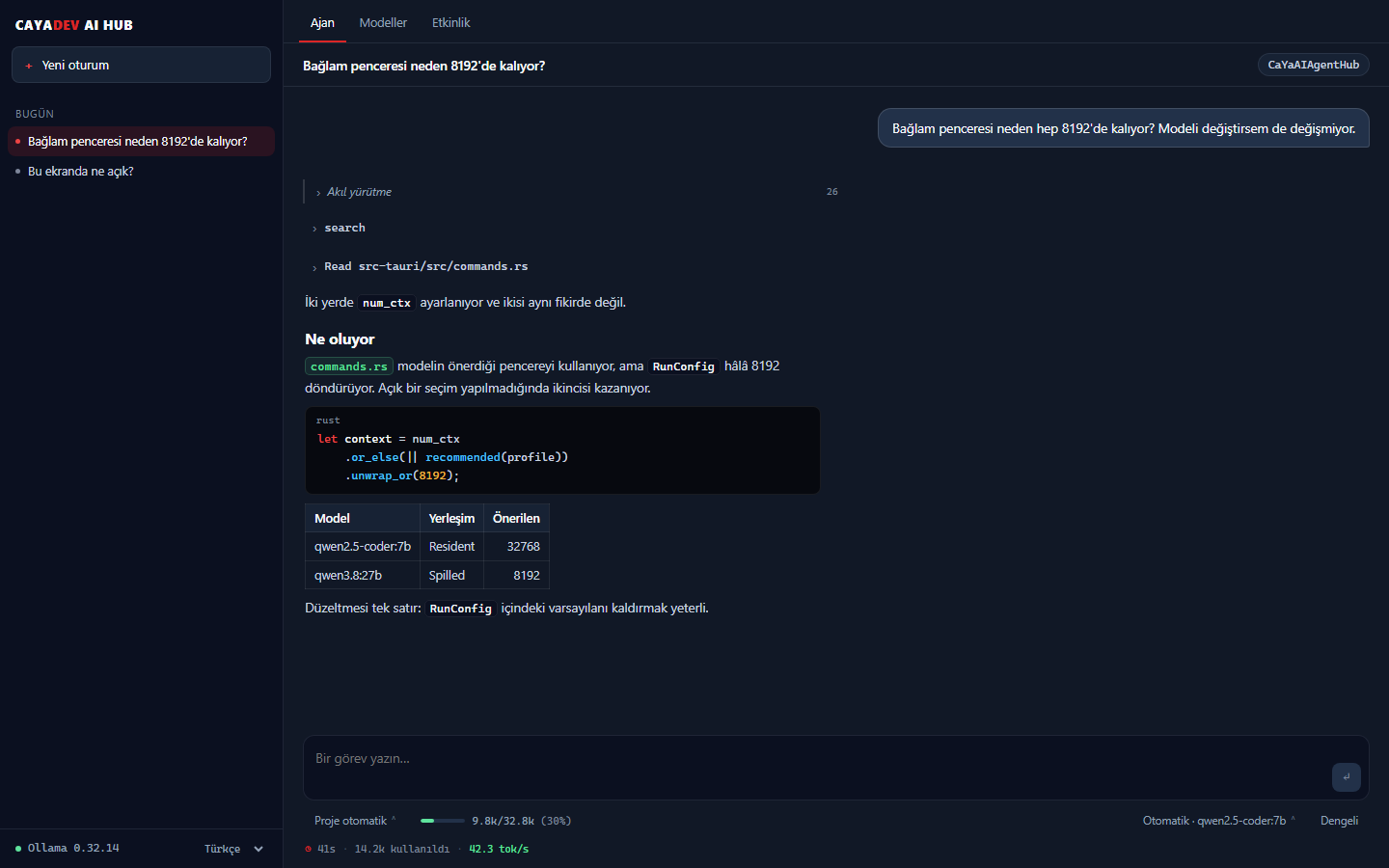
CaYaDev AI Hub
Yayın Tarihi:
CaYaDev AI Hub Capable coding agents on local Ollama models — including the small ones. The problem Point a general-purpose agent tool at a local model and one of two things usually happens: the session dies before any work starts, or it crawls. Both have specific, fixable causes, and neither is really "the model is too small". Symptom Actual cause Session ends immediately The model named a tool that does not exist, and the runner read that as an answer "No tool calls" on a tool-capable model The model emitted bare JSON in the message body, and a strict parser saw prose Says hello, then takes a screenshot Twenty tools on offer and nothing telling the model when not to use one Hangs, then dies A total request timeout fired during a legitimately slow prefill Painfully slow A model too large for available VRAM spilled to system RAM Every row is measured, and every fix is verified against a real model. See docs/BENCHMARKS.md and docs/SPEED.md. What makes it fast Measured on the development machine — an 8 GB laptop GPU: Model Decode TTFT Placement qwen3.8 27B Q4KM 5.4 tok/s 1.5 s 80% CPU / 20% GPU qwen2.5-coder:7b 42.3 tok/s 0.40 s 100% GPU qwen2.5-coder:0.5b 316.3 tok/s 0.19 s 100% GPU A 7B model that fits in VRAM decodes 8x faster than a 27B that does not. No sampling flag closes that gap — context size was measured across a 16x range on the 27B and every result landed within noise of 5 tok/s. So the core feature is task-based routing: planning goes to the strongest model that will actually fit, edits go to the fast resident coder, and the constant yes/no decisions go to a 0.5B that answers in 200 ms. What this does not do: make a 27B model on an 8 GB card fast. Nothing can — that is a memory-bandwidth limit, not a software one. Features Reliability Tolerant tool-call parsing — recovers calls from tags, fenced blocks, tags, bare JSON, and Python-style syntax, with repair for single quotes, unquoted keys, trailing commas, and truncated output Invented tool names are...
Özellikler
- Tolerant tool-call parsing — recovers calls from <tool_call> tags, fenced
- Invented tool names are corrected rather than treated as an answer
- Loop detection that forgets what it saw whenever the run changes something,
- Schema validation, and a step ceiling sized to bound an unattended run
- Idle-based timeouts, so a slow prefill is never mistaken for a hang
- Stop actually stops: the flag is polled before every chunk, and it also
- The conversation is trimmed before it is sent, from the middle, keeping the
- Earlier turns are replayed, with each tool call folded to one summary line, so
- The agent asks rather than guessing: ask_user offers choices or a written
- Task-based routing across reasoning / coding / edit / classify / vision
- GPU memory read from the driver, not assumed
- Byte-stable prompt prefixes — a reused prefix prefills 14.8x faster